
Choosing the right garment decoration method can be overwhelming, especially with options like UV DTF transfer and traditional screen printing. UV printing on fabric through this method delivers vivid color reproduction and detailed imagery, making it a strong choice when design complexity matters and you work with diverse fabrics. When comparing DTF vs screen printing, you’ll find differences in color fidelity, texture, and setup that can influence cost and lead times. Understanding screen printing advantages and disadvantages helps you balance durability, setup, and scalability for different projects. This guide explains how UV DTF transfer works, contrasts it with screen printing, and highlights what makes each method suitable for different garment printing methods and projects, so you can choose a solution that aligns with targets for quality, timelines, and budget.
Alternative terminology for this process includes direct-to-film transfers, where a design is printed onto a carrier sheet with UV-curable inks before being applied to fabric. This direct-to-film workflow leverages film-based media, enabling vibrant, photo-like results on a wide range of materials. In LSI terms, you can think of it as a digital garment decoration pathway that complements traditional methods like screen printing, offering flexibility, easier color control, and faster turnarounds for small batches. When choosing between methods, brands can weigh substrate compatibility, wash durability, and production speed to fit their product strategy across varying garment types.
Understanding UV DTF transfer: How it works and when it excels
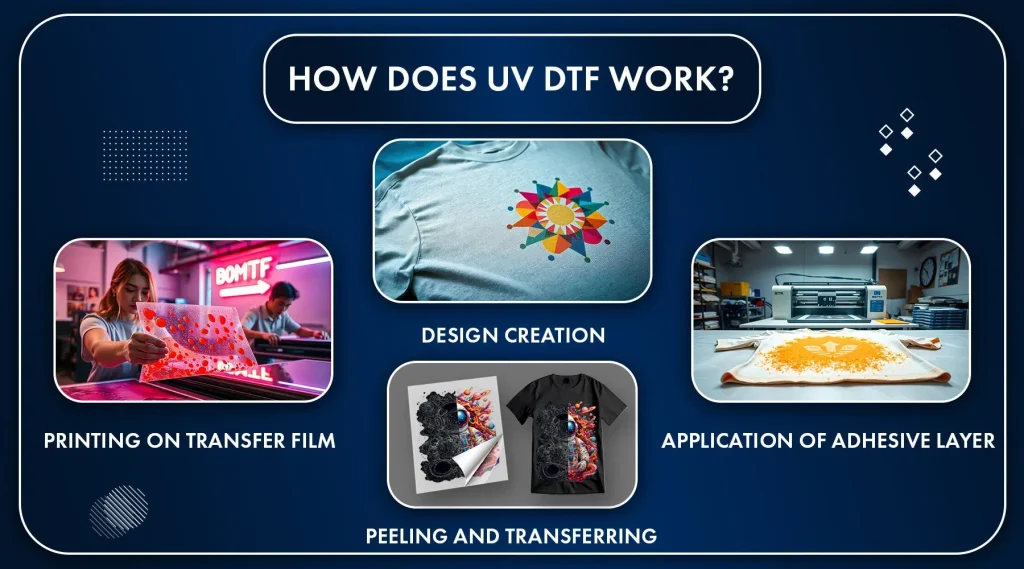
UV DTF transfer uses a direct-to-film workflow with UV-curable inks. A printer lays down a full-color image onto a carrier film, and the inks are cured immediately or after a brief exposure using UV LEDs. This creates a durable, vibrant print that can include fine details and smooth gradients. After printing and curing, a heat transfer is applied to the garment, and the transfer film is peeled away, leaving the image embedded near the fabric surface. This approach blends color fidelity with flexibility, enabling printing on a wide range of fabrics, including blends and synthetics.
UV DTF transfer shines for designs with gradients, photo-like imagery, and highly detailed artwork. It suits print-on-demand workflows and projects that require quick reorders across varied fabrics. For designers evaluating options, UV DTF transfer often delivers a closer resemblance to the original artwork compared to traditional methods, especially when color variety and fidelity across substrates are important.
Screen printing advantages and practical limits
Screen printing is a traditional method that forces ink through a mesh stencil to create an image on fabric. Each color typically requires its own screen, so multi-color designs involve multiple setup steps. The ink is cured with heat, producing a solid, durable print with a distinctive hand. Screen printing excels at large runs and high-opacity colors on cotton and similar substrates.
However, the upfront setup can be time-consuming and costly for multi-color jobs, and achieving photo-realistic detail can be challenging without specialized workflow. While excellent for bold graphics and steady production, screen printing may be less forgiving for complex gradients on non-traditional fabrics without additional expertise or process adjustments.
DTF vs screen printing: a practical comparison for designers
When comparing DTF-based methods to traditional screen printing, color fidelity and detail are key considerations. UV DTF transfer can reproduce fine details and smooth gradients that resemble digital imagery, while screen printing often delivers sharp lines and strong color blocks but may require more screens and color matching to achieve full-color, gradient-heavy designs.
Texture and hand feel also differ: screen prints tend to feel thicker and inkier in large areas, whereas UV DTF transfers usually sit closer to the fabric surface for a lighter touch. Substrate compatibility varies as well—screen printing performs exceptionally on cotton, while UV DTF transfer offers solid results on a broader range of fabrics, including blends and synthetics. This is a core topic in the broader category of garment printing methods.
UV printing on fabric: substrates, color, and care
UV printing on fabric expands substrate versatility to include polyester-heavy blends and synthetic materials. The film-based transfer adapts well to different fabric surfaces, making it a practical option for product lines with mixed materials. The ability to maintain color fidelity on diverse textiles is a central benefit of UV printing on fabric.
Durability and wash performance depend on proper curing and post-processing, and results can vary with fabric type and care instructions. To maximize longevity, it’s important to follow substrate-specific care guidelines and conduct substrate testing before committing large orders. This approach helps ensure consistent outcomes across different garment types and washing conditions.
Choosing by run length: small-batch flexibility vs large-volume efficiency
For small to medium runs with varied designs, UV DTF transfer offers a flexible, quick-turnaround solution. The ability to print full-color images without preparing separate color screens makes it ideal for print-on-demand programs and limited editions, especially on fabrics that benefit from UV printing on fabric.
For large-volume production, screen printing often delivers the lowest per-piece cost and strong coverage on straightforward color palettes. When the project involves thousands of units or bold, opaque graphics on cotton, screen printing’s scalability can be hard to beat. A hybrid approach is also common, using UV DTF transfer for limited editions while relying on screen printing for core product lines.
Practical tips to maximize print quality and longevity
Run a small test by printing samples on the same fabric with both methods to compare color, feel, and wash durability. This side-by-side evaluation helps you make an informed choice based on your fabric mix and design complexity.
Consider your catalog when planning: poly blends and unusual textiles may respond better to UV DTF transfer, while pure cotton can be efficiently produced with screen printing. Plan for color complexity, timeline, and budget, and don’t overlook maintenance—proper curing, care guidelines, and testing are essential for long-lasting results in garment printing methods.
Frequently Asked Questions
What is UV DTF transfer and how does it compare to traditional screen printing in garment printing methods?
UV DTF transfer is a direct-to-film process using UV-curable inks printed onto a carrier film and then heat transferred to fabric. It delivers full-color images with fine detail and smooth gradients and works on a wide range of fabrics. In contrast, screen printing relies on ink passed through a mesh screen; it excels at large runs and high-opacity colors on cotton but requires multiple screens and longer setup for multi-color designs. Overall, UV DTF transfer offers flexibility and detailed reproduction, while screen printing provides cost efficiency at scale and a distinctive hand feel.
How does UV printing on fabric using UV DTF transfer work, and which fabrics are best suited for it?
A printer lays down a full-color image onto a carrier film with UV-curable inks, which are cured immediately by UV LEDs. The film is then heat-transferred to the garment, and the transfer is peeled away to leave the ink on the fabric surface. This process supports a wide range of fabrics, including cotton blends and synthetics, offering good results on diverse substrates, though very stretchy or specialty textiles may require extra care.
What are the screen printing advantages and disadvantages when deciding between UV DTF transfer and screen printing?
Screen printing advantages include strong ink opacity, excellent durability on cotton fabrics, and cost efficiency at high volumes. Disadvantages involve higher upfront setup with screens and color separations, longer lead times for multi-color designs, and less flexibility for detailed or gradient-heavy artwork. When comparing to UV DTF transfer, consider whether your project benefits from scalable runs or needs flexible, detailed full-color reproduction.
For detailed artwork and photography, should I choose UV DTF transfer or screen printing as part of garment printing methods?
For highly detailed artwork and photography, UV DTF transfer generally reproduces fine details and smooth gradients more faithfully than traditional screen printing. Among garment printing methods, UV DTF transfer is favored for complex imagery, while screen printing can still deliver bold, durable graphics with strong color on suitable substrates, especially in fewer-color designs.
Which substrates and durability considerations should I weigh when using UV DTF transfer versus traditional garment printing methods?
UV DTF transfer offers broad substrate versatility, including cotton, blends, and synthetics, whereas screen printing performs best on cotton and similar natural fibers. Durability depends on curing quality and fabric care; screen prints can be extremely durable with proper cure, while UV DTF transfers can also be durable if properly applied and followed by appropriate washing instructions.
What practical tips help decide between UV DTF transfer and screen printing for small runs or large orders in garment printing methods?
Run a small test on the target fabric with both methods to compare color, feel, and wash durability. Consider the garment mix (poly blends may favor UV DTF transfer), design complexity (many colors or gradients suit UV DTF transfer), and timeline (UV DTF transfer often offers faster setup for small runs). Also factor total cost, including setup and per-piece pricing, and plan for future reorders and scalability when choosing between UV DTF transfer and screen printing.
| Aspect | Key Points |
|---|---|
| Overview | UV DTF transfer is a direct-to-film method using UV-curable inks to print full-color designs on a carrier film, which is heat transferred to fabric. |
| How UV DTF transfer works | A printer lays down a full-color image on carrier film; inks are cured with UV LEDs; the transfer is applied to the garment and the film is peeled away, embedding the print in the fabric surface. |
| How screen printing works | Ink is pushed through a mesh stencil; each color needs its own screen, with heat curing to create a durable print; best for large runs and bold colors on cotton. |
| Color fidelity & detail | UV DTF transfer can reproduce complex images with fine detail and gradients; screen printing can be vivid but may require more screens or color matching. |
| Texture & hand feel | UV DTF transfers are generally softer; screen printing can feel thicker where large ink areas are used. |
| Substrate compatibility | DTF offers broader substrate versatility including blends and synthetics; screen printing excels on cotton but may need adjustments for some fabrics. |
| Setup, costs & speed | DTF has upfront costs (printer, film, curing) but can enable faster small runs; screen printing has setup costs per color and scales well for large runs. |
| Durability & wash performance | Both methods can be durable with proper curing; wash performance depends on fabric and care; follow care instructions to maximize longevity. |
| Use-case scenarios | DTF is ideal for small runs, varied designs, gradients, and rapid reprints; screen printing suits large-volume orders with solid colors on cotton. |
| Practical tips | Run side-by-side tests on the intended fabrics; consider garment mix and color requirements; plan timelines and budget carefully. |
Summary
UV DTF transfer is a versatile garment-decoration method that delivers vibrant, full-color images on a wide range of fabrics, including blends and synthetics. By combining detailed image fidelity with a softer hand feel, it enables flexible production for small runs or on-demand orders while maintaining image integrity across diverse materials. When planning a collection, consider UV DTF transfer for complex artwork, gradients, and quick turnarounds, and reserve traditional screen printing for large-volume jobs with solid, opaque colors on cotton. Proper curing, substrate testing, and care instructions are essential to maximize durability and customer satisfaction.